ME2110: Creative Decisions and Design
Led four-month group project to create a high-scoring and reliable machine to compete in Georgia Tech's ME 2110 Robotics Competition and placed in the top 16 of 64 teams.
Deciding what not to build
Early on, part of the team wanted a mechanism for every scoring task. I was worried that would look great on paper and fall apart in fabrication, so I suggested we judge every idea the same way: how many points it could realistically earn, how long it would take to build, what it would cost, and how likely it was to fail. That made the decision straightforward. We kept the scoring actions with the best mix of points and reliability and dropped the rest.
Getting the build back on track
Midway through, we fell behind on fabrication. Part of the problem was that our assignments were too broad, and "work on the intake" is easy to put off. I took ownership of mechanical integration and broke the work into small pieces with clear owners and short deadlines, like "model this bracket by Thursday." Problems showed up early instead of the night before testing, and we finished the robot in time for competition.
The biggest thing I took away: good engineering isn't about making a design do everything. Sometimes it's being disciplined about what to leave out, so the parts you keep actually work.
Background
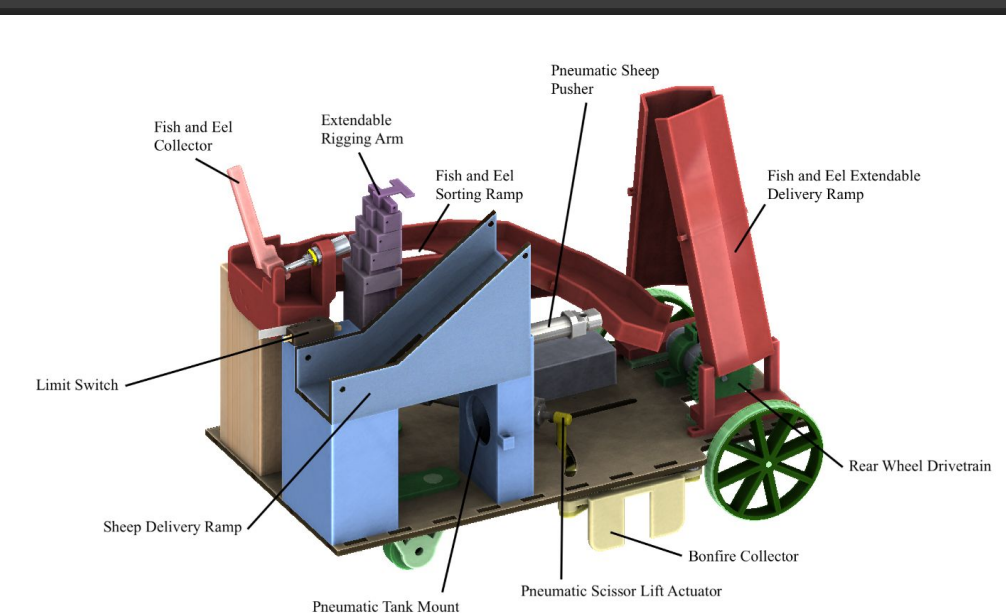
Scored points by: (1) moving forwards to rotating centerpiece, (2) collecting items from rotating centerpiece and depositing them into side pits, (3) depositing items into the rotating centerpiece, (4) depressing lever above the centerpiece etc. within a $120 budget.
Process
Converted competition goals into engineering requirements and functions.
Used a House of Quality, function tree, morphological chart, and solution matrix to select concepts.
Designed the machine in SOLIDWORKS, integrating drivetrain, collection, and scoring mechanisms.
Fabricated parts using laser cutting, 3D printing, bandsaw, and shop tools.
Programmed Arduino, servo motors, limit switches, and pneumatic actuators.
Iterated through repeated prototype, test, and redesign cycles to improve reliability.