Hytech Racing FSAE Motor Simulink Thermal Sim
Led development and usage of Simscape Thermal simulation for Formula Student Electric Car Motor Cooling to justify and test cooling jacket geometries.
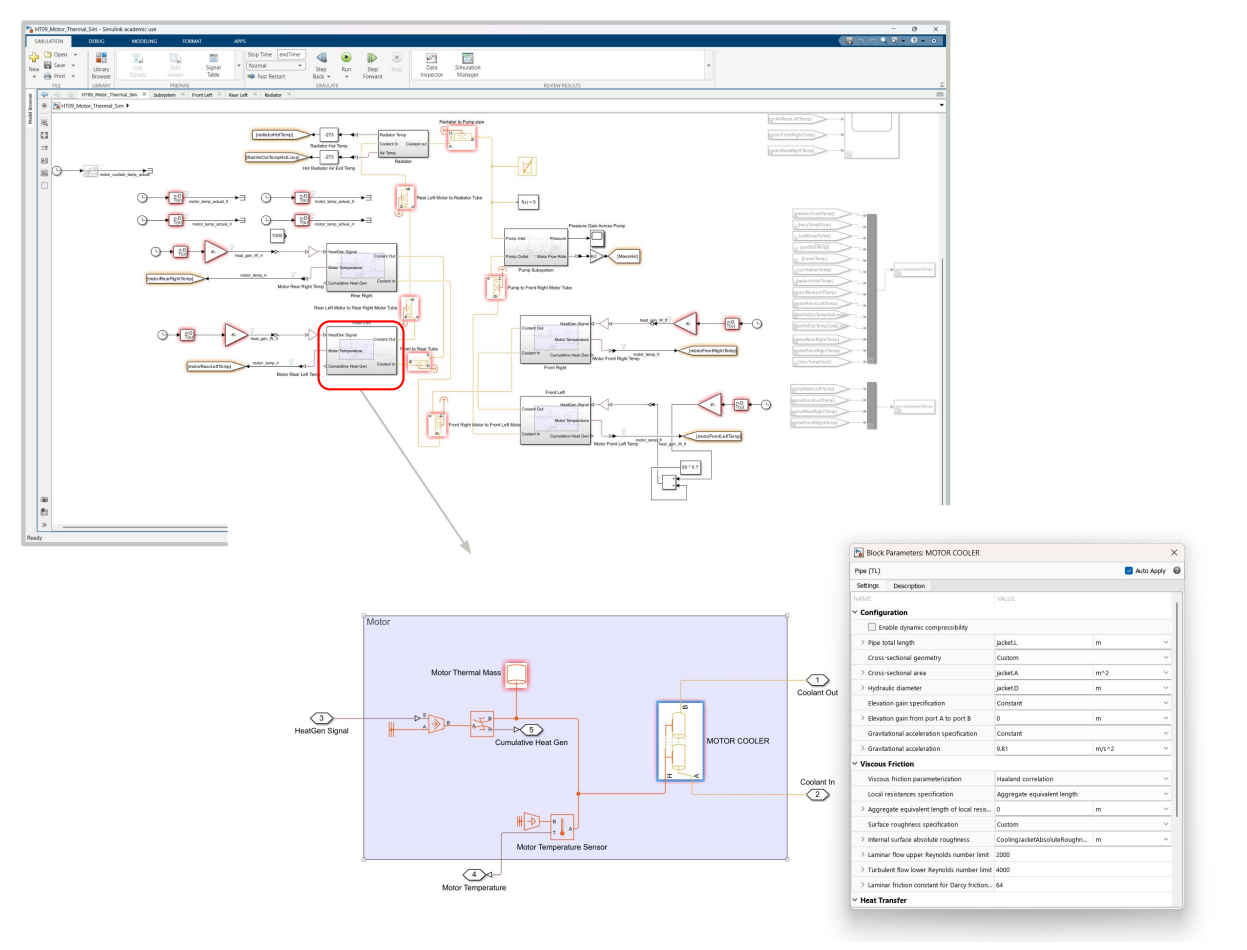
Simulation Specifics
Built a transient Simscape Thermal Liquid model of the FSAE motor cooling loop to predict motor and coolant temperature versus time under race-driving heat loads.
Converted logged motor voltage and current data into time-dependent electrical power and heat-generation profiles; modeled motor losses as thermal energy entering the motor thermal mass.
Represented the cooling jacket using a Simscape Pipe (TL) element parameterized by hydraulic diameter and effective flow length, allowing different jacket geometries to be compared through their effects on coolant flow and heat rejection.
Modeled heat transfer from the motor → cooling jacket → circulating coolant → radiator → ambient, incorporating coolant flow rate, pump behavior, radiator characteristics, and thermal-fluid properties.
Used pump operating data and cooling-loop flow resistance to characterize coolant mass flow rate and pressure drop, allowing thermal performance to be evaluated alongside hydraulic requirements.
Simulated transient temperature response over representative race conditions to determine peak motor temperature, coolant temperature rise, thermal steady state, and cooling-system response time.
Parameterized the model in MATLAB, enabling rapid sweeps of cooling-jacket geometry and operating conditions without rebuilding the Simulink model.
Used simulation results to compare cooling-jacket concepts and determine whether proposed geometries maintained the motor below its allowable operating temperature.
Geometry / Fluid Modeling
Hydraulic diameter: D_h = 4A/P, used to represent non-circular cooling-jacket passages.
Effective flow length: varied to represent different coolant paths around the motor housing.
Evaluated how geometry changes affected flow resistance, coolant residence time, and convective heat transfer.
Used coolant properties and flow conditions to characterize the jacket's thermal response and predict the resulting motor temperature.
Inputs → Model → Outputs
This would also work very well visually on the portfolio:
Inputs:
Voltage/current telemetry • Motor loss profile • Pump curve • Coolant properties • Radiator parameters • Jacket geometry
Simulation:
Motor thermal mass → Motor/jacket heat transfer → Pipe (TL) coolant network → Pump → Radiator → Ambient
Outputs:
Motor temperature • Coolant temperature • Flow rate • Pressure drop • Peak temperature • Cooling performance
Software
MATLAB | Simulink | Simscape | Simscape Fluids / Thermal Liquid